UNRECONCILABLE.COM

When Reconciliation
Is No Longer the Path.

Unreconcilable does not have to mean hostile, bitter, or contentious. Sometimes it simply means the marriage has reached its end.

Amicable does not mean identical interests.

Even when two people agree to move forward respectfully, each may still have individual rights, responsibilities, financial concerns, and decisions that deserve personal consideration.

WHEN THE MARRIAGE WILL NOT CONTINUE

Unreconcilable Is a Conclusion.
Not a Level of Conflict.

Two people can agree that their marriage has reached its end without agreeing on every decision that follows. Some divorces remain cooperative from beginning to end. Others involve issues that require negotiation, mediation, or court involvement.

01

Amicable

Both spouses may agree that the marriage should end and want to move forward respectfully and cooperatively.

Amicable does not mean identical interests.
02

Uncontested

The spouses may have reached agreement on the major issues, allowing the divorce to proceed without a significant dispute over the terms.

Agreement still carries legal and financial consequences.
03

Issues to Resolve

The marriage may clearly be over while questions remain about children, property, finances, support, debt, or other important matters.

Not every disagreement makes a divorce hostile.
04

Contested or Complex

Significant disagreements, substantial assets, business interests, parenting disputes, or other circumstances may require more extensive legal involvement.

The path forward depends on the circumstances.
ONE THING DOES NOT CHANGE

Your Interests Are Still Your Interests.

How cooperative the divorce may be does not determine whether the decisions being made affect you individually. Property, finances, parenting, support, and future obligations can have consequences long after the divorce itself is complete.

That is where personal representation becomes an important question.
WHEN THE MARRIAGE ENDS

One Decision.
Many Issues.

The decision to divorce may be clear. What comes next can involve children, parenting, property, finances, support, and other decisions with long-term consequences.

Some of these matters may already be agreed upon. Others may require negotiation, mediation, or court involvement. How each issue is resolved depends on your circumstances and the laws that apply where you live.

The marriage may be unreconcilable. The issues surrounding its end still have to be resolved.

A VISUAL GUIDE

What Might the Divorce Process Involve?

There is no single path through divorce. This visual introduces common situations and family-law issues that may arise along the way.

Important: The subjects shown below do not represent a required or universal sequence. The issues involved, legal options available, and the order in which matters are addressed depend on the circumstances of the family, the jurisdiction, and applicable law.
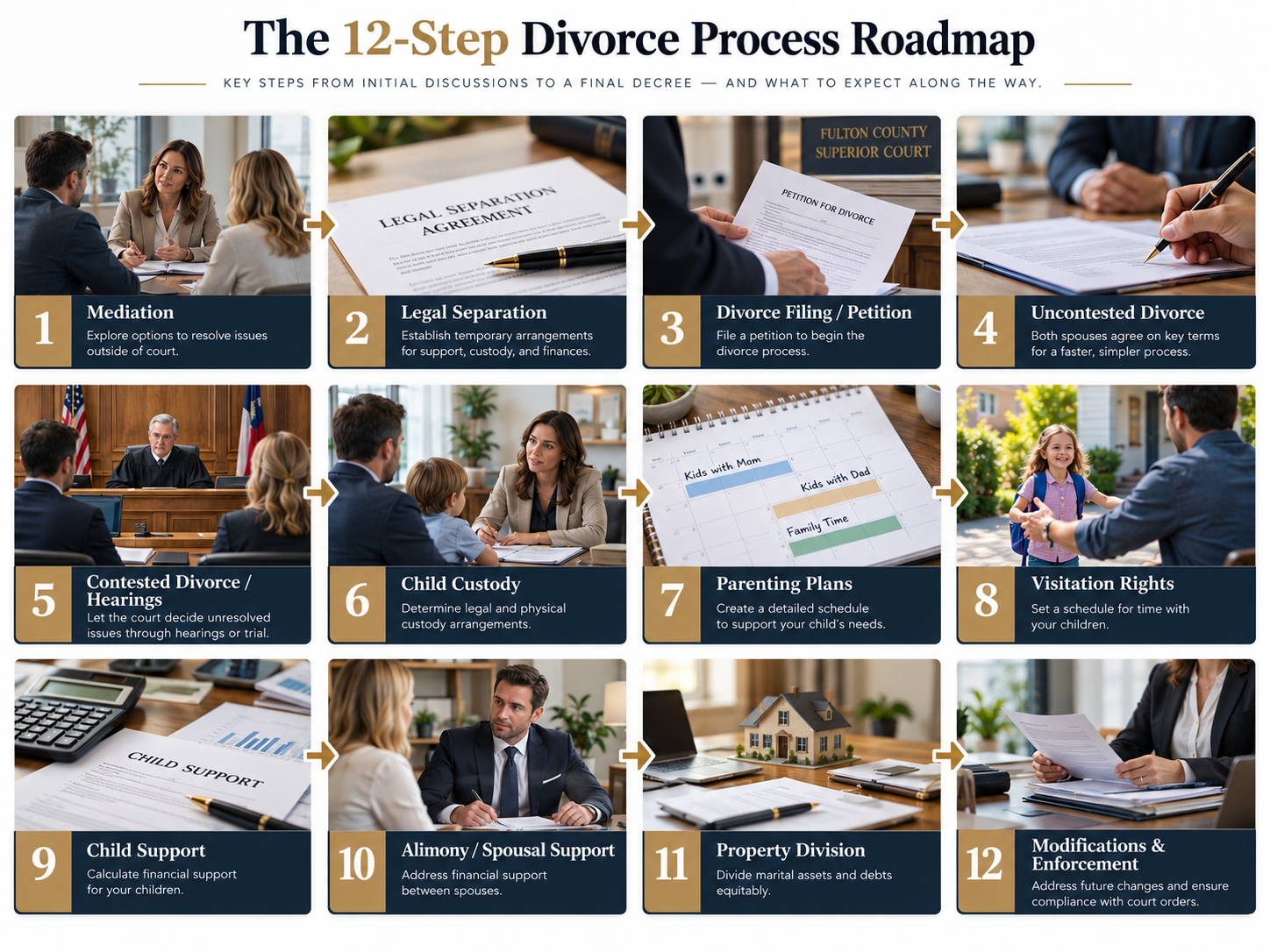
12-step divorce process roadmap covering mediation, legal separation, divorce filing, uncontested and contested divorce, child custody, parenting plans, visitation, child support, alimony, property division, and modifications
Divorce Process Roadmap: An educational overview of some of the issues that may arise before, during, and after divorce. Select the image to view the full-size version.
PERSONAL REPRESENTATION

Who Is Looking Out
for Your Interests?

A divorce can be cooperative without both spouses having identical legal, financial, or personal interests.

AN IMPORTANT DISTINCTION

Amicable Does Not Mean
Identical Interests.

You and your spouse may agree that the marriage should end. You may even agree on many of the decisions that follow. But agreements involving children, property, finances, support, debt, retirement assets, and future obligations can affect each of you differently.

Being cooperative with each other does not require either person to stop considering his or her own interests.

01

Your Spouse's Attorney

If your spouse has an attorney, that attorney represents your spouse's interests — not yours — even when everyone is working toward an amicable resolution.

02

A Mediator

A mediator helps both sides communicate and work toward agreement. The mediator is neutral and generally does not serve as the individual attorney for either spouse.

03

Your Attorney

An attorney representing you can evaluate the proposed decisions from your perspective and help you understand your rights, responsibilities, options, and potential long-term consequences.

COOPERATIVE DOES NOT HAVE TO MEAN UNREPRESENTED

Personal Representation Does Not Have to Create Conflict.

Seeking individual legal advice does not necessarily mean preparing for a courtroom battle. For some people, it is simply a way to better understand an agreement before making decisions that may remain in effect for years.

THE QUESTION IS NOT ONLY “Can we agree?”
IT IS ALSO “Does this agreement protect my interests?”
WHEN YOU WANT SOMEONE LOOKING AT THE DIVORCE FROM YOUR SIDE

Learn About Divorce Attorneys Serving Your Area.

Unreconcilable.com provides independent divorce and family-law information together with professionally presented attorney profiles developed for selected local markets.

WHAT COMES NEXT IS PERSONAL

When the Marriage Is Unreconcilable,
Your Next Step Is To Be Informed.

Divorce decisions can affect your finances, property, children, responsibilities, and future long after the marriage itself has ended. A local divorce attorney can help you understand how the law may apply to your circumstances and discuss the options available to you.

Your interests are yours. Consider speaking with an attorney who can look at the divorce from your side.

Attorney profiles on Unreconcilable.com are provided for informational purposes. Contacting an attorney does not create an attorney-client relationship unless and until one is established directly with that attorney or law firm.

Lorem ipsum dolor sit amet, consectetur adipiscing elit. Ut elit tellus, luctus nec ullamcorper mattis, pulvinar dapibus leo.

Scroll to Top